
How to Choose a Reliable Carpet Fitter (and the Questions to Ask Before You Book)
Ask one question before anything else: will the person quoting the job be the person doing it, and do they power-stretch to BS 5325 rather than relying on a knee-kicker? Beyond that, check for public liability insurance, a written itemised quote (not a verbal estimate), a clear written guarantee, and genuine third-party reviews. Buying from a large retailer doesn't remove this risk - most use self-employed subcontracted fitters, and if the fitting goes wrong, responsibility for it is often disputed between the shop and the fitter.
Most people spend weeks choosing a carpet and about five minutes choosing who fits it. That's the wrong way round. The carpet is a product; the fitting is a skilled trade, and it's the fitting - not the carpet - that determines whether your floor looks right in five years or ripples within five months.
Citizens Advice's 2026 "Built to Fail" research found a quarter of homeowners reported a problem with their most recent repair job - an estimated 4.8 million homeowners affected in the last 18 months, with a median £750 lost fixing or paying extra for issues, and around 1 in 10 losing over £5,000. This guide is the checklist I'd want a homeowner to use before booking anyone, including me.
The One Question That Tells You the Most
"Do you power-stretch the carpet, or do you fit it with a knee-kicker?" A knee-kicker is a hand tool that can position carpet onto gripper rods, but it can't generate even, sustained tension across a whole room. A power stretcher - a pole tool braced wall-to-wall - can. Fitting to British Standard BS 5325 means power-stretching larger rooms rather than relying on a knee-kicker alone, and it's the single biggest factor in whether a carpet stays flat for years or starts rippling within weeks. If a fitter tells you they don't need one, that's your answer.
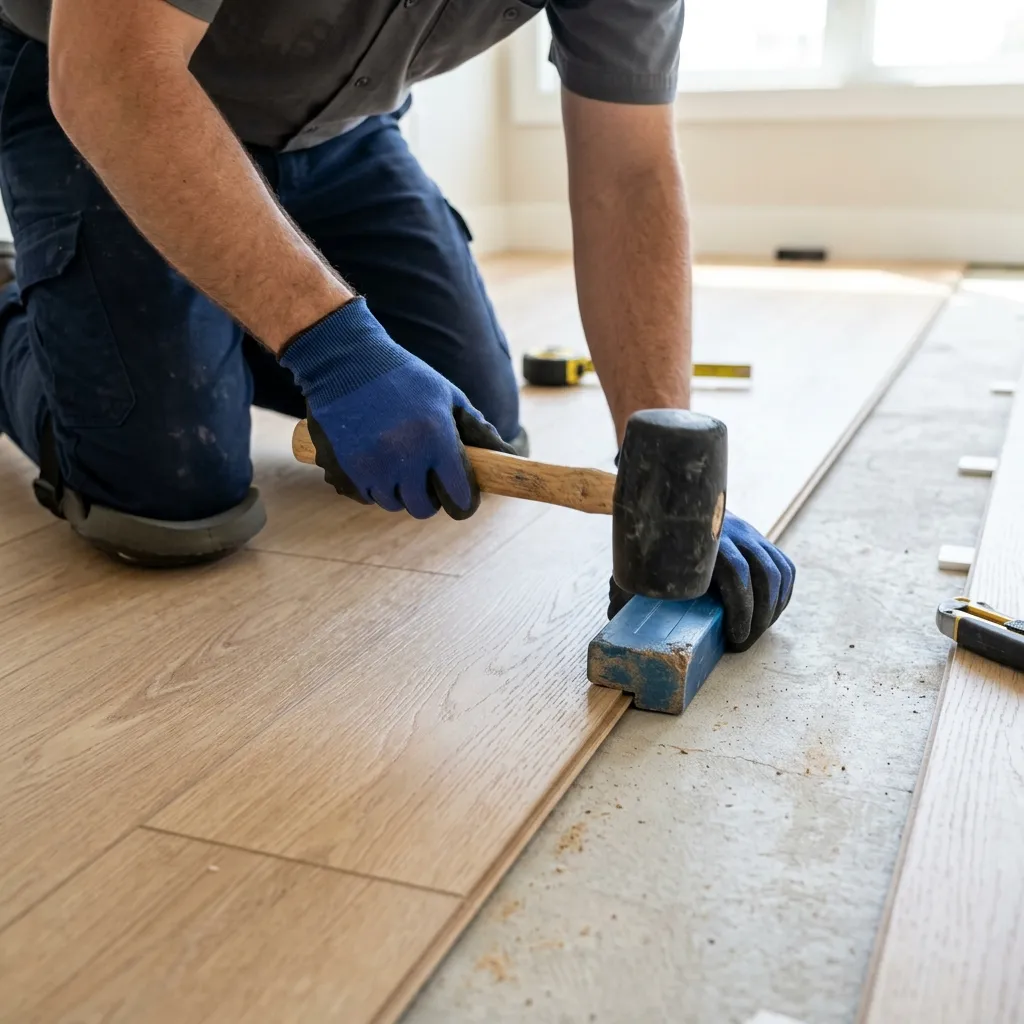
Why "I Bought It From a Big Retailer" Doesn't Remove the Risk
It's a reasonable assumption that a large, well-known shop carries less risk than an independent tradesperson. But accreditation isn't the safeguard it sounds like: Citizens Advice found one in five people (20%) who used an approved or accredited trader said it was actually difficult to verify their credentials. And a "big brand" doesn't change who's on your floor - the reason comes down to how the fitting itself is actually contracted.
Most large carpet retailers sell carpet, but they don't directly employ the person who fits it - the fitting is carried out by a self-employed subcontractor, often booked through the retailer but working independently. That's not automatically a problem, but it becomes one when something goes wrong and the retailer and the fitter each say it's the other's responsibility. On MoneySavingExpert, one customer's dispute over poor Carpetright fitting describes being told by the retailer that they were "only the agent" for the self-employed fitter and held no responsibility for how the job was carried out - leaving the customer to resolve it directly with a tradesperson they never chose. That's one customer's account of one dispute, not a claim about how every job with that retailer goes, but the underlying contract structure it describes - carpet from the shop, fitting from an independent subcontractor - is the industry norm, not the exception.
This isn't a claim that any specific big retailer does bad work - plenty of subcontracted fitters do a fine job. It's a structural point: when you book a fitter directly, there's one person accountable for the whole job, from the quote to the final sweep. When fitting is subcontracted through a retailer, that accountability can get split, and disputes about who's responsible are a recurring pattern in UK consumer forums.
One person, one quote, one guarantee
I survey, quote, fit and guarantee every job myself - no subcontractors, ever. If something needs fixing afterwards, you're calling the person who did the work, not a call centre.
Real Examples: What Goes Wrong With Subcontracted Fitting
These aren't hypothetical risks. UK consumer forums have plenty of first-hand accounts of subcontracted fitting jobs going badly:
- On Reddit's r/DIYUK, one poster described a Tapi subcontracted team leaving one fitter alone on a large job, then rushing to finish - resulting in scuffed skirting boards and visible damage.
- Another r/DIYUK thread describes a Tapi job halted halfway through and fully refunded after the subcontracted fitting was judged too poor to continue.
- A third describes a Tapi subcontracted fitter arriving late with poor communication, then refusing to complete the agreed scope of work.
- On MoneySavingExpert, one thread details missing grippers, no door bars, and patched stair carpet despite the customer having asked for everything to be included in the price.
- Another describes needing multiple return visits to fix lifted joints and missing underlay after the original fitting.
None of this means subcontracted fitters are always bad - most tradespeople, employed or subcontracted, do decent work. But it's exactly why the checklist below matters more than which shop sold you the carpet.
The Trustworthy-Fitter Checklist
Run through this before you book anyone. A fitter who's genuinely good at their job won't mind a single one of these questions.
- Specialisation. Are they a dedicated flooring fitter, or a general handyman who "also does carpets"? Specialisation matters for subfloor prep, adhesive choice and stretching technique.
- Standards. Do they explicitly work to BS 5325 for textile floor coverings (carpet) and BS 8203 for resilient floor coverings (LVT, vinyl)? Can they describe how they power-stretch a larger room?
- Insurance. Do they carry public liability insurance, and will they show you a current certificate on request? This protects you if something is damaged or someone is injured during the job.
- Trade membership. Are they registered with a body like the NICF, CFA or FITA, or a scheme like TrustMark? These bodies set codes of practice and can be independently checked.
- Subcontracting, stated plainly. Will the person who quotes the job be the person who does it? If you're buying through a retailer, ask directly who your contract is with if the fitting goes wrong.
- A written, itemised quote - not a verbal estimate. It should show materials, underlay, grippers, thresholds, subfloor prep, uplift and disposal, and VAT as separate line items, not one lump sum.
- Sensible payment terms. Staged payments (e.g. on survey, on materials, on completion) rather than everything upfront in cash, and card or bank transfer rather than cash-only.
- Real, verifiable reviews. Recent, third-party reviews (not just testimonials on their own site) and photos of actual completed jobs, ideally with references you could contact.
- A stated approach to subfloor moisture and prep. Ask how they test for damp (a hygrometer, not a guess) and how they handle an uneven or previously tiled subfloor.
- A written fitting guarantee. Ideally covering wrinkling, loose seams and transitions for at least a year or two, with a clear process for what happens if something needs fixing.
- No pressure to book immediately. Genuinely busy, in-demand fitters are booked weeks ahead. Doorstep cold-calling and "today-only" pricing are classic rogue-trader pressure tactics, not a good deal - get a genuine written quote and take the time to compare it.
What a Proper Quote Should Include
A fair, professional quote is written and itemised, not a number given over the phone. At minimum, it should show: the fitter's name, trading name and contact details; the exact scope (which rooms, stairs, landings, thresholds); the product specification (carpet or LVT range, underlay type and thickness, gripper type); a separate labour and subfloor-prep line; whether the work is subcontracted; confirmation of insurance and guarantee terms; and the total price including VAT, with payment terms clearly stated. If any of these is missing or vague - especially subfloor prep or who's actually doing the work - treat that as a reason to ask more questions or get a second quote before booking. For what typical UK carpet fitting actually costs once you have a proper quote in hand, see our UK carpet fitting cost guide and, for South London specifically, our South London price guide.
Frequently Asked Questions
Does buying from a big retailer guarantee a better fitting job?
What's the single most important question to ask a carpet fitter?
Should I get a verbal estimate or a written quote?
Is it a red flag if a fitter can start immediately?
What should a carpet fitting guarantee actually cover?
What This Looks Like Booking Me
I survey every job myself, quote it myself in writing, fit it myself and stand behind it myself - there's no subcontractor, no call centre and no separate company to argue with if something needs a second look. Every carpet is power-stretched to BS 5325, and every LVT and vinyl job follows BS 8203 subfloor prep. If you're weighing up costs before you call anyone, our UK cost guide and guide to carpet wrinkling and re-stretching cover what to expect once you've found a fitter you trust.
Areas I Cover
Based in South London, covering Surrey, Kent and Sussex with the mobile showroom:
Get Your Exact Price
Three fields. Paul replies personally — usually within the hour, always the same day.
Prefer WhatsApp? Send a photo of your room to 07903 320 414 for a faster estimate.